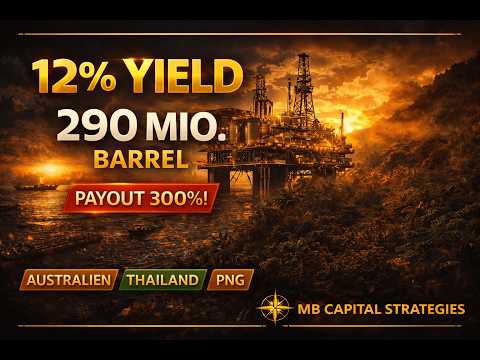
Horizon Oil (ASX:HZN) is an Australian upstream explorer with operations in China, Australia (Mereenie), Thailand (ex-ExxonMobil), and a major PNG gas project with 290M barrels of reserves. The stock pays 12% dividend — but the payout ratio exceeds 300%. Sustainable or dividend cut on the way?
Related: BHP vs Rio Tinto 2026: mining dividend comparison
What Does Horizon Oil Do?
Horizon Oil is a small-cap upstream player with three producing pillars and one major development asset:
See also: dividend calculator.
1. Mereenie (Northern Territory, Australia)
25% interest in a producing oil & gas field. Stable cashflow source, low OPEX. JV with Central Petroleum (operator).
2. Beibu Gulf (China)
26.95% stake in three producing licenses offshore Guangxi province. Operator: CNOOC. Output: ~2,500 BOE/day (HZN share). License runs through 2030+ with extension options.
3. Thailand Acquisition (ex-ExxonMobil, 2025)
Closed November 2025: 50% interest in three producing onshore licenses in Thailand. Production boost: +2,000 BOE/day. Acquisition price: $42M — payback period under 3 years at current oil prices.
4. PNG Gas Project (Western Province)
The Big Asset — Undeveloped
50% stake in a gas project with 290M barrels of oil equivalent in Western Province, Papua New Guinea. JV with Osaka Gas. In negotiation for years — main issue: pipeline connection to Total's LNG facility in Port Moresby. If realized: balance-sheet game-changer. But: development costs estimated at $1.2B — HZN needs partners.
2025 Fundamentals
- Revenue: AUD 76M (FY2025, +18% YoY post-Thailand)
- Operating Cashflow: AUD 22M
- Net Income: AUD 8M
- Free Cashflow: AUD 4M after CapEx
- Net Debt: AUD 12M (solid balance sheet)
- Market Cap: AUD 86M
The Dividend Question
HZN has paid two dividends over the past 18 months: 2 cents AUD in April 2025 (semi-annual) and 2 cents AUD in October 2025. Annualized at a share price of 33 cents, that's a 12% yield.
Possible scenarios:
- Best case: Thailand boost lifts FCF to AUD 12M/year, dividend halved to 2 cents annualized, yield stays at 6% — realistic.
- Mid case: Dividend suspended for 12 months, funds redirected to PNG pre-FEED.
- Worst case: Oil below $70, Thailand integration struggles, dividend fully cut.
Valuation
- EV/EBITDA: 3.4x — below sector average of 5.1x
- P/Reserves (2P): $0.29/barrel — cheap vs. peers ($1.80+)
- P/E: 11x — not cheap given the risk
- NAV discount: ~35% (sum-of-parts including PNG optionality)
Peer Comparison: Horizon Oil vs. Small-Cap Upstream Alternatives
Horizon Oil is not alone in the sub-$500M market cap upstream space. Here is how it compares to similar companies I track:
| Company | Yield | EV/EBITDA | FCF Cover | Risk |
|---|---|---|---|---|
| Horizon Oil (HZN) | ~12% | 3.4x | <0.8x | HIGH |
| DNO ASA (DNO) | 9.5% | 2.8x | 1.6x | MED |
| Serica Energy (SQZ) | 8% | 2.1x | 1.9x | MED |
| Cardinal Energy (CJ) | 11% | 4.2x | 1.4x | MED |
Illustrative, based on public data and own estimates. Not financial advice. Verify before investing.
The pattern is clear: Horizon Oil offers the most assets (PNG optionality) but the worst dividend coverage. DNO and Serica deliver comparable or better yields with genuine free cash flow (FCF) support. For income-focused investors, those alternatives are structurally superior.
The PNG Optionality Case — Why Bulls Are Not Wrong
The bull case for Horizon Oil is essentially a bet on the Western Province LNG project in Papua New Guinea. Here is what the numbers look like if the project proceeds:
- Resource base: 290 million barrels of oil equivalent (2C contingent resources) — the largest undeveloped asset by far
- Development partners: Total Energy and local PNG entities have expressed interest; binding FID has not been taken as of early 2026
- Timeline risk: PNG LNG projects have a history of multi-year delays (cf. Papua LNG by TotalEnergies, delayed 2019 → 2024+). Execution risk is extreme in this jurisdiction
- Upside scenario: If PNG LNG reaches FID and first gas by 2030, the project could triple the company's production base and fully justify current NAV calculations
My view: The PNG project is optionality, not a business plan. Paying a 12% yield today while waiting for a resource development that may take 5+ years is a poor risk/reward proposition. Options on junior resource developers should be sized accordingly — maximum 1-2% of a diversified portfolio, not a core dividend position.
My Verdict
Horizon Oil has real optionality through the PNG project. But the 12% dividend is a yield trap: it's only sustainable because management is mining reserves. A dividend cut within 12 months is my base case. Anyone who wants to play the PNG story should wait for the dividend cut — the stock will be significantly cheaper then.
Buy threshold: < 22 cents AUD after dividend cut. Not in my portfolio. Not on my immediate watchlist.
The Horizon Oil case illustrates a broader principle: in upstream oil and gas, nominal yield is the least reliable signal of value. A company distributing 300% of its FCF is, by definition, returning capital rather than generating income. Investors attracted by the 12% headline yield are financing their own distributions. The correct screening framework — FCF yield, payout coverage, reserve replacement ratio, and breakeven oil price — would have filtered out Horizon Oil at the research stage, before the high yield became a temptation.
Calculate Your Own Returns
YOC, Dividend Snowball, Cashflow & Financial Freedom — all calculators free and ready to use.
YOC Calculator → All Calculators →Horizon Oil vs. Small-Cap Upstream Peers: Dividend Quality Scorecard
Small-cap upstream oil producers carry a unique risk profile: concentrated reserves, limited balance sheet cushion, and dividend sustainability tied directly to oil prices. Here is how Horizon compares:
| Company | Reserves (2P) | Breakeven (Brent) | Dividend | Jurisdiction Risk |
|---|---|---|---|---|
| Horizon Oil | ~70 MMboe | ~$30/bbl | Variable | PNG + China — medium |
| Panoro Energy | ~30 MMboe | ~$25/bbl | Variable + buyback | Africa (Tunisia/Gabon) — medium-high |
| Energean | ~700 MMboe | ~$20/bbl | Fixed quarterly $0.30 | Mediterranean — medium |
| Cardinal Energy | ~60 MMboe | ~$28/bbl | Monthly C$0.06 | Canada — low |
The key differentiator for Horizon is the PNG gas business — long-duration, contracted, low-breakeven assets that most small-cap upstream operators lack. That gas revenue cushions oil price volatility and funds the shareholder return program when crude prices soften. It is the reason Horizon can sustain distributions at $55-60/bbl Brent where competitors would be cutting dividends. Investors comparing small-cap upstream names should weight the gas-revenue stability and reserve life as the primary quality filter — not just current yield or production volume.
See also: All Upstream Stocks Overview | Cardinal Energy Analysis | YOC Calculator
2026 Outlook: Key Catalysts and Risks to Watch
For 2026, Horizon Oil's investment case rests on two separate catalysts that operate on different timelines. In the near term, the Mereenie and Beibu Gulf assets continue generating cash flow tied to oil prices — with Brent at $80–90, these assets fund the existing capital return program comfortably. The Thailand acquisition adds production volume and broadens the geographic base, reducing concentration risk.
The longer-term catalyst is PNG gas development progress. Any binding offtake agreement or FID announcement on the PNG Western Province project would be a material value realization event — the market currently assigns minimal value to this asset despite its 2P reserve size. The risk is that the development timeline extends further, or that PNG government conditions on local content and revenue sharing become more onerous than modeled.
Commodity cycle positioning matters here: upstream stocks tend to outperform in mid-cycle when oil prices are in the $70–90 range — high enough for strong cash generation but not so high that market participants fear demand destruction or OPEC supply releases. Horizon sits in a favorable zone if that price band holds through 2026. The key risk to monitor is Chinese demand softening, which directly impacts Beibu Gulf economics and removes what has been a supportive pricing pillar for Asian-basin crude.
Disclaimer: This analysis is for informational purposes only and does not constitute financial advice, investment advice, or a solicitation to buy or sell any security. All content reflects the personal opinion of the author. Past performance is not indicative of future results. Always do your own research and consult a qualified financial adviser before making investment decisions.
Understanding FCF for dividends? → Free Cash Flow Explained: Why FCF Is the Only Metric That Matters →
Further reading: Best High-Yield Dividend Stocks 2026: Upstream & Specialty

Independent hard-asset investor since 2022. Covers dividends from shipping, mining, energy & pipelines from a real private-investor portfolio — with disclosed positions on every analysis.
Related income plays: CMB.Tech $0.64 Dividend June 2026 | Best Tanker Stocks 2026 | YOC Calculator