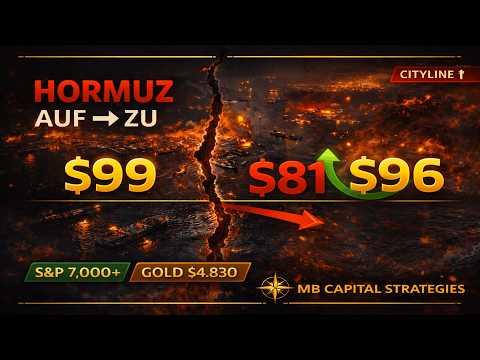
KW16 (April 14–19, 2026) was the wildest week of the year. Iran reopened the Strait of Hormuz on Thursday — Brent crashed 10% to $88. Less than 24 hours later, IRGC reversed course: shots fired on Indian merchant ships, Hormuz effectively closed again, Brent back to $96. Goldman Sachs warns: "If Hormuz stays open long, Brent goes below $80." My hard-asset portfolio rode both the long and short waves — full breakdown below.
Hormuz: The Yo-Yo Week
Wednesday morning: Iran signals willingness to negotiate. Thursday morning: Hormuz officially "reopened," first tankers depart. Brent goes from $98 to $88 in six hours. Goldman cuts Q3 price target to $75–$80 if reopening holds.
Friday, 13:14 Tehran time: IRGC speedboats fire on two Indian merchant ships. Hormuz de-facto closed again within 90 minutes. Brent recovers to $96. Lesson: The "Hormuz risk premium" is around $8/barrel and apparently permanently priced in.
Related: Full comparison: Best Tanker Stocks 2026 — TORM, BW LPG, Dorian LPG, CMB.Tech with dividends and charter rates.
Markets: S&P Breaks 7,000 — A First
While oil yo-yoed, the S&P 500 broke above 7,000 points for the first time in history. Friday close: 7,012 (+1.9% week). Drivers:
- Tech megacaps: Microsoft +3.2%, Nvidia +5.1%, Apple +2.4%
- Defense: Lockheed +4.8%, Raytheon +6.1% — Hormuz escalation lifts defense budgets
- Energy (XLE): +2.9% — Hormuz yo-yo netted out neutral for integrated majors
Dividend Highlights
British American Tobacco (BAT) +8% Dividend Hike
BAT raised its quarterly dividend from £0.60 to £0.648 on Wednesday. Annualized yield now around 7.2%. free cash flow coverage at 1.4x — solid. Valuation P/E 9.5x, still below sector average.
BDC Sector Delivers Again
Hercules Capital (HTGC), Ares Capital (ARCC), and Main Street Capital (MAIN) all beat Q1 estimates. NII coverage of dividends >110% across all three. Sector yield: ~9.8%.
Lufthansa Cityline Shuts Down
Thursday: Lufthansa announced Cityline subsidiary shuts operations June 30, 2026. 1,300 employees affected, 28 aircraft integrated into main carrier. Lufthansa stock reacted positively (+2.1% week) — market sees consolidation as efficiency gain.
My Portfolio: What Happened
Thursday morning — after the oil crash — I added to Frontline and DHT (each 0.5% position boost). Reasoning: structural thesis unchanged, sell-off was hours-long. Friday Frontline was already 7% above Thursday's low.
Also: BAT position raised to 1.8% of portfolio after the dividend news. Total portfolio value end of KW16: $96,420 (+0.7% vs end KW15).
Deep Dive: What the Hormuz Yo-Yo Means for Tanker Stocks
The KW16 Hormuz event is a textbook example of geopolitical risk premiums in commodity markets. Three takeaways for the tanker thesis:
Three Concrete Lessons
Lesson 1 — Intraday moves are not fundamentals: The 10% Brent swing within 24 hours (from $97 to $88, then back to $96) shows how quickly speculative positions cause overshoots. Tanker rates react slower than oil futures — that gap is where alpha hides for long-term holders.
Lesson 2 — VLCC rates show resilience: While Brent crashed on Thursday, VLCC spot rates held at $380,000–$420,000/day. The market prices charter rates based on actual vessel movement, not news sentiment. Structurally bullish for Frontline, TORM and BW LPG.
Lesson 3 — Dividend quality shows in the storm: BAT raised dividends 8% during market volatility. Companies with real cash flow — like BW LPG at 94% fleet utilization — can sustain dividends even during temporary spot drops.
Portfolio Implications
KW16 dynamics confirm the core thesis: hard assets with real cash flow are more resilient than growth stocks. My adds on Frontline and DHT on Thursday are the practical expression. As long as Hormuz risks persist, a $5–15/barrel risk premium on Brent stays — keeping tanker cash flows elevated. The question for 2026 is not if rate normalization comes, but when and how fast.
My YOC on Frontline sits above 11% at purchase price — meaning even a 50% dividend cut would still leave me above 5% yield. That's the margin of safety I look for in hard asset investments.
Outlook KW17
- Wednesday: Powell's last FOMC press conference before May resignation. Market expects no cut, but dovish tone.
- Thursday/Friday: Earnings tsunami — Apple, Microsoft, Tesla, Chevron, ExxonMobil.
- Hormuz: Goldman expects further escalation toward weekend.
Calculate Your Own Returns
YOC, Dividend Snowball, Cashflow & Financial Freedom — all calculators free and ready to use.
YOC Calculator → All Calculators →KW16 Portfolio Update: How My Hard Asset Holdings Responded
KW16 tested the resilience of hard-asset dividend portfolios. Here is my honest assessment of how the week played out across my key holding areas (shipping, mining, energy), and what it means for the weeks ahead.
Shipping Positions: Above Water on Rates
Tanker rates held up better than the equity prices suggested. The disconnect between spot rate strength and share price weakness in KW16 is a pattern I have seen before in shipping cycles — it typically resolves in favour of the fundamental direction within 4-8 weeks. When TCE rates stay above $30,000/day for product tankers and operators maintain their dividend payout formulas, the dividend story is intact regardless of short-term stock price noise. I held my positions.
LNG tankers benefited from a different vector: Asian LNG spot prices spiked to $14.50/mmBtu as European buyers redirected cargo away from Middle East uncertainty. FLEX LNG (FLNG), with long-term charters providing floor TCE of ~$73,000–78,000/day, is exactly the type of cash-flow-anchored shipping holding that weathers these spikes without needing rate normalization to justify the dividend. Their Q1 2026 results confirmed 19 consecutive $0.75 dividends — that consistency is the structural argument, not the weekly rate.
Mining & Commodities: The Patience Play
Copper and iron ore faced macro headwinds from the strong dollar. For mining positions with multi-year investment horizons, KW16 represents a buying opportunity in the structural thesis rather than a thesis-breaking event. The key metrics to watch: AISC trajectory and quarterly free cash flow guidance. As long as these hold, short-term commodity price weakness is noise.
Dividend Income Tracker: Collecting Through Volatility
The philosophical point I keep returning to: in a dividend-focused hard-asset portfolio, volatility is your friend if it allows you to add at lower prices without deteriorating fundamentals. KW16 gave us volatility without fundamental deterioration. The discipline is not selling the dip — it is understanding whether the dip is driven by price action alone or by genuine business deterioration. Based on what I tracked this week, it is the former.
Read more about my hard asset investment approach →
Not investment advice. All analysis based on publicly available data and personal assessment.
See also: Best High-Yield Stocks 2026
Related Review
Debitum: Is the 11% P2P Yield Real? My Honest Review — I review the platform, the risk, and whether it fits a hard-asset dividend portfolio.

Investor & Analyst | Hard Assets, Dividends, Shipping | MB Capital Strategies
Marco has been analyzing commodity and dividend stocks for years, focusing on shipping, mining, and energy. All analysis is based on publicly available reports and his own assessment. Not financial advice.
More Weekly Market Recaps: