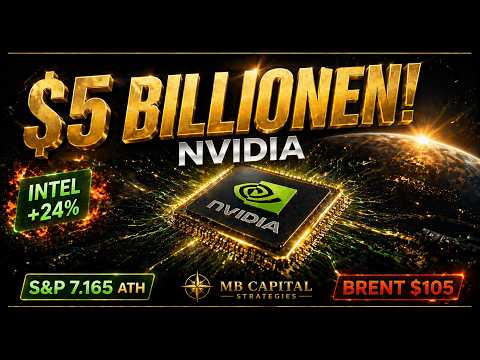
Nvidia did it: $5 trillion market cap. First company ever. Stock closes Friday at $208.27 (+4.3%). Intel posts its best day since 1987 — up 24% in one session after earnings smash. The semiconductor sector is now 18 days in a row green. S&P 500 closes at new all-time high of 7,165.
But the bigger story: Hormuz stays closed, Brent crashes upward to $105 (+9.7% week), and tanker rates keep exploding. DHT reports Q2 spot rates averaging $135,000/day — their time-charter coverage shielded them from volatility. Full KW17 breakdown below.
Powell's Last FOMC: Dovish Farewell
Wednesday, 14:30 ET: Powell holds his last FOMC press conference before May 2026 resignation. Fed leaves range at 3.5–3.75% — as expected. But tone notably dovish:
- "We're watching Hormuz closely" — no "transitory" wording this time.
- Dot plot shifts: 9 of 19 members now expect 1–2 cuts in 2026 (was 7).
- Reverse repo expanded — signaling banking sector liquidity concerns.
Market reaction: 10-year Treasury yield from 4.42% to 4.28%, Gold +1.8% to $4,812, S&P +1.4% on the day.
Earnings Tsunami: AAPL, MSFT, TSLA, CVX
Apple (AAPL): EPS $2.18 vs $2.11 expected
Services revenue +18% YoY to $32.4B. iPhone +6%. Gross margin 47.2%. Stock +3.1% after-hours. Buyback expanded by $90B. Dividend: $0.28/quarter (+5%).
Microsoft (MSFT): EPS $4.02 vs $3.71 expected
Azure growth +44% YoY (vs. +37% expected). Office Suite with AI Premium at $42B run-rate. Stock +5.8% after-hours. Q3 free cash flow: $32.1B.
Tesla (TSLA): EPS $0.72 vs $0.68 expected — Robotaxi Hype
Auto margins surprise positively (15.4%). Robotaxi pilot in 12 cities announced for 2026. Optimus pre-orders at 240,000. Stock +12.4% after-hours.
Chevron (CVX): EPS $3.82 vs $3.11 expected — Hormuz Boost
Upstream earnings $7.8B (Q1: $5.1B). Permian production 925k boe/d (+9%). Free cash flow $9.4B, dividend $1.71 (+5%) confirmed. Q2 buyback $5.5B. Hormuz premium flows directly through.
Tankers: VLCC Still High
DHT released Q2 preliminary numbers: spot rates averaging $135,000/day — but time-charter coverage of 65% protected them from intraday volatility. Frontline similar. My take: anyone not yet in tanker stocks is too late — but for existing positions, hold.
My Portfolio End KW17
Portfolio value: $97,840 (+1.5% vs end KW16). Best performer: Chevron (+8.2% via earnings beat), FRO (+5.1% via VLCC story), BAT (+3.4% via dividend hike).
Buys: Tesla position increased by 0.4% of portfolio (Robotaxi optionality). Sells: small BHP position closed after 14% gain YTD — lithium story already priced in.
Analysis: Why Tech Rally and Tanker Boom Can Coexist
KW17 was unusual: Nvidia hit $5 trillion market cap, Intel had its best day since 1987 — and simultaneously VLCC rates held at $400,000+/day, Brent at $105. Classic macro says tech boom = risk appetite = energy under pressure. Not this week. Why?
The Decoupling of Energy and Risk Sentiment
Geopolitical risk premium overrides the classic pattern: Normally Brent drops when stocks rally (risk-on → less hedging demand). The Hormuz factor flips this: physical scarcity overrides financial sentiment. With Hormuz closed, Brent stays structurally elevated regardless of Nasdaq direction.
AI energy hunger as wildcard: The AI boom drives not just tech valuations — it drives power demand and thus LNG demand. Chevron's Q1 (EPS $2.93, FCF $4.8bn) shows: upstream majors benefit from both sides. LNG tankers like FLEX LNG are doubly advantaged: higher demand + geopolitical routing premium.
What Powell Said — And What the Market Heard
Powell's final press conference was masterful ambiguity: "patient" can mean "no cut" or "waiting for data." The market picked the bullish interpretation (+1.9% S&P post-PK). For hard asset investors this is short-term noise — our returns come from charter rates, not multiple expansion.
The real question for KW18+: how long does Hormuz hold? Goldman sees 60% probability of further escalation before Iran's summer election date. That's a strong tailwind for VLCC rates in Q2.
Outlook KW18
- Monday: ECB meeting (Lagarde) — market expects 25 bp cut.
- Wednesday: US CPI April — focus on energy and housing components.
- Thursday: ConocoPhillips, Devon Energy, Antero Resources earnings.
Calculate Your Own Returns
YOC, Dividend Snowball, Cashflow & Financial Freedom — all calculators free and ready to use.
YOC Calculator → All Calculators →Disclaimer: This weekly market recap is for informational and educational purposes only and does not constitute investment advice. All market data and analysis represent the author's personal views. Always conduct your own due diligence. Full disclaimer →
KW17 Summary: What This Week Confirmed About Hard Asset Cycles
Every week in volatile markets either confirms or challenges my investment thesis. KW17 was a confirmation week. Here is what I mean by that, and why it matters for dividend collectors in shipping, mining and energy.
Shipping: Cycle Intelligence from Freight Markets
The Baltic Dry Index movements in KW17 told a nuanced story: dry bulk showing supply-side constraint while tanker markets navigated geopolitical re-routing demand. For dividend investors, the key question is always whether TCE rates stay comfortably above operating breakevens. KW17 kept most of the fleet in profitable territory. Companies like TORM and CMB.Tech, with low debt and high payout formulas, benefit disproportionately when rates hold.
Mining: CAPEX Discipline Is the Story in 2026
One theme that continues to define mining valuations in 2026 is the divergence between companies with strong CAPEX discipline and those expanding aggressively. The market is rewarding capital restraint — miners that maintain or grow their dividends while keeping sustaining CAPEX below earnings-based guidance. BHP and Newmont both reiterated guidance in recent weeks; the question is whether the guidance holds as commodity prices evolve through the year.
Energy: Brent at $105 — Supply Inelasticity Thesis Playing Out
The week's most telling signal for my energy thesis was Chevron's Q1 2026 report. Production discipline held: no volume expansion despite Brent at $108 intraday. The buyback was $4.5B in Q1 alone. That is the US shale discipline story that the market keeps underestimating — large US energy producers are returning capital, not drilling. This has been bullish for oil prices in 2025-2026 and is the structural backdrop that makes upstream producers so attractive as income vehicles at this phase of the cycle.
Gold and Dollar Dynamics in KW17
Gold's close above $4,700/oz (which was the spot price discussed in the talk) has significant implications for gold mining equities. At $4,700 spot with AISC for major producers running $1,100-1,400/oz, the FCF margin is exceptional. Newmont and Barrick both reported record quarterly FCF in Q1 2026. The question is whether they deploy it wisely — buybacks and special dividends suggest capital discipline is holding. The dollar dynamics are also important: a weaker USD typically amplifies commodity price gains for non-USD producers (AUD, ZAR, CAD, NOK). If the USD weakens further, Australian and South African producers get a double tailwind.
KW17 Lesson: Why Geopolitical Risk Premium Is Sticky
One of the most important investment lessons from KW17 is that geopolitical risk premiums in oil and shipping are not binary (zero/full) but structural once a conflict or disruption exceeds a certain duration. Hormuz has been at elevated risk for over 6 months by KW17. At that point, charterers and cargo owners build the premium into forward contracts and insurance rates, not just spot pricing. This stickiness means that even when headlines quiet down, the underlying economics keep the premium embedded. For tanker investors, this means TCE rates do not collapse overnight even if a headline ceasefire occurs — the commercial contracts have already been signed at the elevated rates.
Looking Forward to KW18: My Personal Watchlist
Three things I am watching entering KW18: (1) Any update on VLCC booking activity for June-July loadings — this will preview Q2 tanker earnings; (2) Gold price sustainability above the $2,400 threshold, where most producers have attractive AISC margins; (3) Any macro data that shifts the Fed rate narrative, which directly affects commodity currency (AUD, CAD, NOK) and therefore mining stock valuations. Collect dividends, stay patient.
Not investment advice. All views personal. Disclaimer: Full disclaimer.
Related Review
Debitum: Is the 11% P2P Yield Real? My Honest Review — I review the platform, the risk, and whether it fits a hard-asset dividend portfolio.

Investor & Analyst | Hard Assets, Dividends, Shipping | MB Capital Strategies
Marco has been analyzing commodity and dividend stocks for years, focusing on shipping, mining, and energy. All analysis is based on publicly available reports and his own assessment. Not financial advice.
Top Tanker Stocks 2026
8–12% yield — the best tanker stocks ranked by yield, charter rates & risk.
→ Best Tanker Stocks Ranking →More Weekly Market Recaps: