Aker BP (AKRBP) 2026: Aker BP (AKRBP) 2026: Norway's lowest-cost oil producer with Brent break-even ~$30/bbl — world-class efficiency from Johan Sverdrup (31.7% stake, one of the world's cheapest assets). Monthly dividend yield: ~8–10%, covered by FCF at $50+ Brent. Marco's thesis: Aker BP is the best risk/reward in European upstream for investors who understand Norway's petroleum tax regime (78% allowances stabilize after-tax cash flows). Not pure oil leverage — structured cash flow that holds up in a $60 oil world. Monitor: Johan Castberg project start-up (2024+) as the next FCF step-change.
Verwandte Analyse: Compare Aker BP with Devon Energy, ConocoPhillips and Energean in our upstream stocks overview — Upstream Oil & Gas Stocks Hub
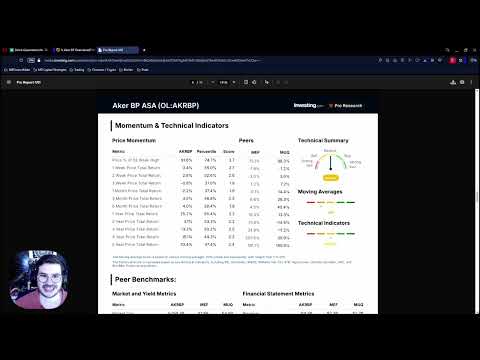
Company Overview
Aker BP ASA (OTC: AKRBP) is a Norwegian independent exploration and production company focused exclusively on the Norwegian Continental Shelf (NCS). With a market capitalization of approximately $18 billion, Aker BP is the second-largest operator on the NCS behind Equinor and one of Europe's premier pure-play upstream companies. The company is majority-owned by Aker ASA (21.2%) and BP plc (27.4%), providing strategic alignment with two major industrial groups. Aker BP was formed through a series of mergers culminating in the transformative 2022 acquisition of Lundin Energy's E&P business, which brought the world-class Johan Sverdrup stake into the portfolio.
→ full upstream oil & gas stocks overview
The company's strategic focus is simple and compelling: operate the highest-quality assets on the NCS, maintain industry-leading capital efficiency, and return maximum cash to shareholders. Unlike many European energy peers that are diversifying into renewables, Aker BP remains unapologetically focused on oil and gas, arguing that the NCS offers the lowest-carbon-intensity barrels in the world and that returning cash to investors is more productive than pursuing unfamiliar businesses.
Review: Debitum Investments Review 2026 — Is 10%+ yield from SME loans in the EU sustainable? Marco's honest assessment.
Glossary: Debt/EBITDA explained — the leverage ratio for capital-intensive shipping and mining companies, and what thresholds signal balance sheet risk.
Glossary: Cashflow Coverage explained — the most important dividend safety metric: how well does the company's cash flow cover its dividend?
Glossary: CAPEX explained — Capital expenditure and why high capex at commodity companies can signal future dividend pressure.
Glossary: P/E Ratio explained — when a low P/E is a bargain and when it's a value trap — especially important for cyclical commodity stocks.
Glossary: Dividend Safety explained — payout ratio, FCF coverage, net debt, and the 5 metrics that predict dividend cuts before they happen.
Glossary: Dividend Yield explained — the difference between current yield and Yield on Cost, and when a high yield is a red flag.
Glossary: Free Cash Flow (FCF) explained — why FCF is more important than earnings for dividend investors, and how to calculate it from annual reports.
Context: Commodity Supercycle explained — the structural demand drivers behind why mining, shipping, and energy stocks could outperform for years.
Hub: Best High-Yield Dividend Stocks 2026 — top stocks paying 6–15% dividends in shipping, mining, and energy, ranked by yield and safety.
Tool: Dividend Calculator — quickly calculate annual dividend income and compare multiple stocks side by side.
Production Profile
Aker BP's production stands at approximately 440,000-460,000 boe/d following the Lundin integration, making it one of the largest independent producers in Europe. The production mix is approximately 65% liquids and 35% natural gas. The crown jewel is a 31.6% operating interest in the Johan Sverdrup field, the largest North Sea discovery in decades, which contributes roughly 250,000 boe/d net to Aker BP. Sverdrup's full-field production of 755,000 bbl/d from two processing platforms represents extraordinary value, and the field's estimated ultimate recovery has been repeatedly revised upward since first oil in 2019.
Advanced Tool: Snowball YOC Pro — model long-term YOC growth with dividend reinvestment + annual DGR assumptions for any income stock.
Beyond Sverdrup, Aker BP operates the Valhall, Alvheim, Skarv, Edvard Grieg, and Ivar Aasen fields — a portfolio of mature, cash-generative assets. The NOAKA area development (Noa and Krafla fields), currently under construction with first oil expected in 2027, represents the next major production increment and is estimated to deliver 80,000-100,000 boe/d gross at plateau. The Yggdrasil development, one of the largest NCS projects in recent years, is progressing with expected first oil in 2027 and peak production around 250,000 boe/d gross.
Break-Even Analysis
Aker BP's portfolio-wide break-even is approximately $25/bbl Brent, among the absolute lowest of any publicly traded E&P company globally. Johan Sverdrup alone operates at a cash cost below $2/bbl and a full-cycle break-even near $15-20/bbl due to the field's enormous scale, high recovery rates, and shared infrastructure. The legacy Valhall and Alvheim fields carry higher but still competitive break-evens in the $30-35/bbl range. The NOAKA and Yggdrasil developments are sanctioned at break-evens below $35/bbl, ensuring that even significant organic growth maintains the company's low-cost production profile. At $75/bbl Brent, Aker BP generates approximately $6-7 billion in operating cash flow and $4-4.5 billion in free cash flow, an extraordinary level of cash generation for a company of its market capitalization.
Dividend Model
Aker BP has one of the most aggressive dividend policies in the global E&P sector, targeting distributions of $2.00 per share annually paid in quarterly installments of $0.50. At current prices, this produces a dividend yield of approximately 8.1%. The company has maintained this distribution through various commodity price environments, demonstrating the resilience provided by its low break-even costs. Management has indicated a willingness to supplement the base dividend with special distributions when balance sheet conditions permit, and the company has periodically delivered extraordinary dividends of $0.50-1.00 per share. The high payout is supported by a target leverage ratio of 1.0-1.5x net debt-to-EBITDAX, which provides reasonable financial flexibility while maximizing distributions. Norwegian withholding tax of 25% applies to US investors, reclaimable to 15% under the tax treaty.
Key Risks
- Johan Sverdrup concentration: The Sverdrup field represents over 50% of Aker BP's production and an even larger share of cash flow. Any operational disruption, accelerated decline, or unexpected reservoir issues would have an outsized impact on the company's financial performance.
- Norwegian fiscal risk: The temporary petroleum tax increases of 2022-2024 demonstrated the Norwegian government's willingness to capture windfall profits. Permanent changes to the fiscal regime could erode Aker BP's exceptional after-tax economics.
- Development execution: NOAKA and Yggdrasil are multi-billion dollar projects with construction and commissioning risk. Cost inflation in the Norwegian offshore services market has been significant, potentially pressuring project economics.
- NCS decline rates: While individual fields are long-life, the NCS as a province is in structural production decline. Maintaining aggregate production requires continuous investment in new developments and field life extensions.
- OTC liquidity for US investors: Aker BP trades primarily on the Oslo Stock Exchange, and the OTC ADR has limited liquidity, creating execution challenges for US-based investors.
Investment Thesis
Aker BP is arguably the single best pure-play upstream income stock available to global investors. The combination of an 8.1% dividend yield, a $25/bbl break-even, and a 12.8% free cash flow yield creates an income proposition that is virtually unmatched in the sector. The Johan Sverdrup field is a generational asset that will generate enormous cash flows for decades, and the NOAKA and Yggdrasil developments provide visible production growth that extends the company's runway well into the 2030s. The pure NCS focus eliminates geopolitical risk, and Norway's transparent regulatory environment provides investor confidence in property rights and fiscal stability (with the caveat of periodic tax adjustments). The primary concern is concentration risk in Sverdrup, but this is mitigated by the field's proven operational reliability and vast remaining reserves. For income investors willing to navigate Norwegian withholding tax and OTC execution, Aker BP deserves a core position in any energy-focused portfolio.
Valuation Snapshot (2026)
| Metric | Aker BP | Sector Median |
|---|---|---|
| P/E Ratio | 6.5× | 9.2× |
| EV/EBITDA | 4.1× | 5.8× |
| FCF Yield | 12.8% | 7.4% |
| Dividend Yield | 8.1% | 4.2% |
| Break-even Price | $25/bbl | $45/bbl |
Source: Company reports, Bloomberg consensus estimates, March 2026. Sector median = European E&P peer group.
My Take: Portfolio Context
For a hard-asset income portfolio, Aker BP fills the "high-quality upstream at attractive valuation" slot. Unlike variable-dividend shipping stocks or cyclical miners, Aker BP offers a relatively predictable $2.00/share annual base dividend supported by a low-cost asset base. The Sverdrup field alone justifies ownership at current valuations — everything else (NOAKA, Yggdrasil, Valhall) is optionality. The Norwegian tax treatment for European investors is straightforward, and the company's financial discipline (disciplined capex, targeted leverage) gives me confidence in dividend continuity even at $55-60/bbl Brent. This is a stock I hold and monitor quarterly. The key metric I watch: Johan Sverdrup quarterly production versus guidance. Any persistent underperformance there changes the thesis materially.
Related Upstream Analyses
- Panoro Energy 2026: 50% NAV Discount Deep Value
- Devon Energy 2026: 8% Variable Dividend
- Energean 2026: 10% Yield Mediterranean Gas Producer
- Chevron (CVX) 2026: Buy or Overvalued?
- APA Corporation 2026: Permian + Suriname Play
- Equinor Analysis
- ConocoPhillips Analysis
- FLEX LNG Q1 2026: 9% Dividend + LNG Market
- BW LPG Q1 2026: $0.67 Dividend — Triple Pay Day
- Oil & Gas Investing Guide 2026: Upstream Stocks & Dividend FCF
→ Compare: Energean ENOG 2026 — 10% Yield, Mediterranean Gas
Understanding FCF for dividends? → Free Cash Flow Explained: Why FCF Is the Only Metric That Matters →
How safe is the dividend? → Dividend Coverage Ratio Explained — Payout Safety Metric →
Disclaimer: This analysis is provided for informational and educational purposes only and does not constitute investment advice, a recommendation, or a solicitation to buy or sell any security. All data is based on publicly available information and estimates as of March 2026. Past performance does not guarantee future results. Always conduct your own due diligence and consult a qualified financial advisor before making investment decisions.
🇩🇪 Deutsche Version: Diesen Artikel auf Deutsch lesen | 🌐 MB Capital Strategies (DE)
Related: See all dividend stock analysis on MB Capital Strategies.