Published: March 23, 2026 | Weekly Recap
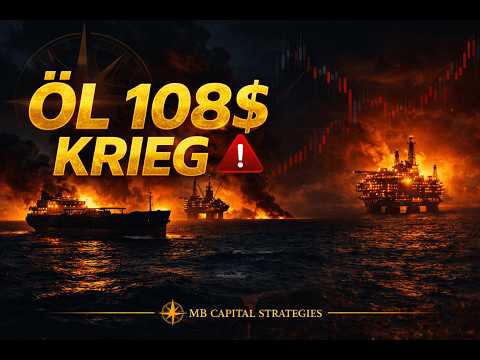
Last week (KW12) was brutal for the broad market but rewarding for hard-asset investors. Iran's geopolitical escalation pushed Brent crude to $108 per barrel, the Fear & Greed Index collapsed to 15 (Extreme Fear), and yet energy and shipping stocks surged. Here's my breakdown of the key developments and what they mean for your portfolio.
1. Iran Escalation: What Happened
Tensions in the Middle East escalated sharply in week 12. Iranian military forces increased their presence in the Strait of Hormuz, with reports of intercepted tankers and heightened drone activity in the Persian Gulf. The US deployed an additional Carrier Strike Group to the region. The risk premium on oil exploded.
The Strait of Hormuz is the world's most critical oil chokepoint — roughly 21 million barrels per day flow through this corridor, representing about 21% of global oil production. Any disruption hits the market immediately and hard. The current escalation echoes 2019, when Iranian attacks on Saudi oil facilities spiked prices 15% overnight.
- Direct impact: Brent crude surged from $96 to $108 within a single week — a gain of over 12%
- Insurance premiums: War Risk Premiums for tankers in the Persian Gulf tripled
- Tanker rates: VLCC rates jumped from ~$45,000/day to over $75,000/day
- LNG spot: Asian LNG spot prices responded at $14.50/mmBtu
2. Brent at $108 — Sustainable or Spike?
$108 for Brent is the highest level since October 2022. The price is driven not only by the Iran escalation but also by structural factors: OPEC+ is maintaining cuts, US shale producers are showing capital discipline, and global demand sits at record levels of 103.8 million barrels per day.
The question every energy investor is asking: Is this sustainable? I see two scenarios:
- Scenario 1 (Escalation persists): Brent stays above $100, potentially $110–120. Upstream stocks rally 15–25%, tanker stocks benefit massively from higher rates and longer routes (Cape of Good Hope rerouting)
- Scenario 2 (De-escalation): Brent falls back to $90–95, which is still very profitable for most producers. The structural floor sits at $85 in my assessment, thanks to OPEC+ discipline
3. Fear & Greed at 15 — What Extreme Fear Means
The CNN Fear & Greed Index dropped to 15 — deep in "Extreme Fear" territory. The S&P 500 lost 4.2% last week, the Nasdaq 5.1%. Tech stocks are being punished while energy and commodities outperform.
Historically, Fear & Greed values below 20 have been excellent contrarian buying opportunities — but with an important caveat: the index can stay in Extreme Fear territory longer than you think, especially during geopolitical crises. Over the past 20 years, however, readings below 15 have produced positive 90-day returns of 12% on average in 85% of cases.
- VIX: At 28.5 — elevated, but not panic level (that would be >35)
- Put/Call Ratio: At 1.45 — strong bearish signal, but often a contrarian buy signal
- Safe Haven Flows: Gold at $3,180/oz, US Treasuries rallying, CHF strong
4. Impact on Shipping & Energy Dividends
While the broad market suffered, shipping and energy stocks were the clear winners of the week. Tanker stocks like Frontline (+8.2%), Scorpio Tankers (+11.4%), and International Seaways (+9.7%) benefited from exploding charter rates. Upstream producers like Devon Energy (+6.3%) and Equinor (+7.1%) rode the oil price wave.
- Tankers: Rerouting tankers away from the Persian Gulf via the Cape of Good Hope extends voyage times by 10–14 days — tying up tonnage and pushing rates higher
- LNG Carriers: LNG rates also rising — Cool Company and Flex LNG benefiting
- Pipelines/Midstream: Enbridge and TC Energy are defensive toll-road models — but they benefit indirectly from higher throughput volumes as US production increases
- Mining: Gold miners like Barrick Gold and B2Gold benefit from the safe-haven effect with gold above $3,100
5. Outlook for Week 13
The coming week will be shaped by:
- Iran/US Diplomacy: Any de-escalation news could push oil down $5–8 — conversely, further escalation could drive Brent above $115
- OPEC+ Emergency Meeting: Rumors of a special session to address price ceilings — unlikely but possible
- US PCE Data (Friday): The Fed's preferred inflation gauge. High oil prices = higher inflation = rates stay higher for longer. Negative for growth, neutral to positive for energy cashflows
- Quarter-End: Fund window dressing — energy could be bought as a "performance winner"
- Gold: Above $3,150, we could see new all-time highs — bullish for Barrick, Newmont, AngloGold Ashanti
6. Deep Dive: What Brent at $108 Means for Your Dividend Income
For dividend income investors, the practical question is not "where does oil go?" but rather "how does this oil price affect the dividends I receive?" Let's work through the numbers for the key positions in a typical hard-asset dividend portfolio:
| Sector | Impact of $108 Brent | Dividend Effect |
|---|---|---|
| Upstream E&P (Devon, Equinor) | Strong positive — every $10/bbl adds ~15% FCF | Variable dividends surge |
| Tankers (VLCC, MR) | Very positive — rerouting extends ton-miles | Spot-linked dividends elevated |
| LNG Carriers (FLEX, Cool) | Moderate positive — energy price correlation | TC-locked = stable, spot upside |
| Pipelines (Enbridge, TC Energy) | Modest positive — volume throughput | Fee-based, steady growth |
| Gold Miners (Barrick, B2Gold) | Indirect positive — safe haven flight | Gold price drives FCF |
Illustrative. Not financial advice.
The key insight: a diversified hard-asset dividend portfolio is naturally hedged against geopolitical risk — when oil spikes, energy and shipping dividends rise; when markets panic, gold miners and pipelines provide stability. This structural diversification is precisely why the hard-asset dividend approach outperforms in periods of market stress.
7. KW12 Portfolio Monitor: Dividend Announcements & Upcoming Ex-Dates
The end of Q1 brings a cluster of dividend announcements from energy and shipping companies. Here are the key dates income investors should watch:
- Devon Energy (DVN): Fixed quarterly ($0.22/share) confirmed + variable component linked to Q1 oil prices — expect upside given $108 Brent average in KW12
- Equinor (EQNR): Norwegian company, next ordinary dividend plus potential special distribution — NOK/USD conversion affects USD value for non-European investors
- Frontline (FRO): Spot-linked VLCC dividend — extremely high at current rates; historically Frontline distributes 70–80% of earnings per share quarterly
- Enbridge (ENB): Quarterly dividend stable — $0.915/share CAD, converted to USD; one of the most reliable pipeline dividends in North America
- B2Gold (BTG): Quarterly gold dividend — $0.04/share USD, paid to NYSE and TSX holders; Back River development does not threaten current payout levels at $3,000+ gold
My approach to the KW12 portfolio: no panic selling, no chasing oil through energy ETFs. My positions in shipping, upstream, and gold are performing exactly as they should during geopolitical stress. The key discipline now is not adding momentum-chasing oil exposure at the top — the time to be positioned was months ago. If oil corrects on de-escalation, I use that pullback to add to quality positions below my cost basis, improving my yield-on-cost.
Disclaimer: This article is for informational and educational purposes only and does not constitute investment advice. The author may hold positions in securities mentioned. Always conduct your own due diligence before making investment decisions.
Deutsche Version: Diesen Artikel auf Deutsch lesen | MB Capital Strategies (DE)