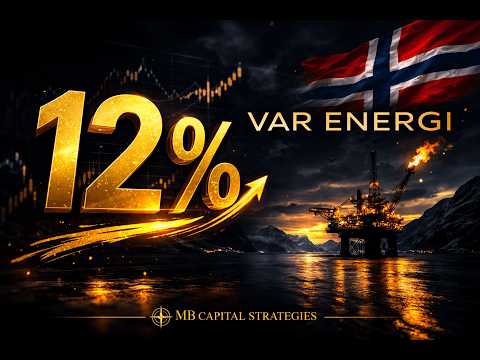
What Sets Var Energi Apart in 2026
Var Energi ASA (Oslo: VAR) is the third-largest oil and gas producer on the Norwegian Continental Shelf (NCS), formed in 2018 from the merger of Eni's Norwegian operations with Point Resources (formerly ExxonMobil Norway). Italian energy major Eni SpA holds approximately 63% of the shares. Market cap: roughly USD 7.5-8 billion at current prices.
The key differentiator versus Equinor or Aker BP: Var Energi is the only one of the three major NCS producers that is actively building production rather than just maintaining it. Q4 2025 was the strongest production quarter in company history at 397k boe/d. The 2026 guidance of 390-410k boe/d shows this is not a one-time spike — it is the new baseline.
Q4 2025 Results — What the Numbers Actually Show
Q4 2025 came in stronger than expected. The 397,000 boe/d represented a 7% increase versus Q3 2025. Main drivers: ramp-up of the Balder Jotun FPSO and significantly lower unplanned maintenance downtime. Johan Castberg is running stably, its ramp-up on track.
- Q3 2025: approx. 371,000 boe/d
- Q4 2025: 397,000 boe/d (+7% QoQ) — record
- 2026 Guidance: 390,000–410,000 boe/d
- Production cost target 2026: ~USD 10/boe
- Development capex 2026: USD 2.5–2.7 billion
The Q1 2026 dividend was set at USD 300 million (NOK 1.209 per share), paid February 12, 2026 — consistent with the dividend policy of 25-30% of cash flow from operations after tax. At 43-44 NOK, that annualises to approximately 11-13% yield.
Fundamentals at a Glance
| Ticker | VAR (Oslo Stock Exchange) / VARRY (OTC) |
| Share price (April 2026) | approx. 43–44 NOK |
| Market cap | approx. USD 7.5–8 billion |
| Major shareholder | Eni SpA (~63%) |
| P/E ratio (forward) | approx. 11.5x |
| Dividend yield (TTM) | approx. 12–13% |
| Q4 2025 production | 397,000 boe/d (record) |
| 2026 production guidance | 390,000–410,000 boe/d |
| Production cost 2026e | ~USD 10/boe |
| Development capex 2026 | USD 2.5–2.7 billion |
| Portfolio break-even | approx. $30–35/barrel Brent |
| Net debt / EBITDAX | approx. 1.0–1.2x |
Why the Pullback to 43 NOK Is Not a Disaster
My take: the stock dropped from ~50 NOK to ~43 NOK — roughly 14%. But the operational picture improved. Q4 was a record quarter, 2026 guidance is solid, the dividend was confirmed at USD 300M. What drove the price down was a broader oil price decline and sector rotation away from energy — not a company-specific issue.
At 43-44 NOK and an annualised dividend of approximately NOK 4.8-5.0 per share (based on Q1 2026 extrapolated), the yield is over 11-12%. Yield-on-cost point: someone who bought at 50 NOK is now sitting on roughly 9.5-10% YOC. Someone buying today starts above 11%. With a $30-35 break-even and Brent well above that level, the dividend is cash-flow covered. That separates Var Energi from producers with break-evens at $55-60.
Var Energi vs. Aker BP — Which Is More Attractive?
Aker BP is the other major NCS growth story. Both are capital-efficient NCS producers with high dividends. Key differences:
- Dividend yield: Var Energi ~12-13% vs. Aker BP ~9-10%
- Production growth: Var Energi already hit near-400k boe/d in Q4 2025 — Aker BP's FCF boom is expected from 2027 onwards
- Ownership structure: Var Energi = Eni-controlled (63%), Aker BP = Aker-controlled
- P/E ratio: Var Energi ~11.5x vs. Aker BP ~14-15x
- My take: For income now, Var Energi is cheaper. For long-term FCF upside, Aker BP has the better story from 2027. Both can make sense in a dividend portfolio.
Key Risks
- Eni control risk: With 63% ownership, Eni controls strategy. Conflict potential: Eni needs cash for its own dividend, while Var Energi might optimally reinvest.
- Oil price sensitivity: Below $55 Brent, the variable dividend component gets cut first. The base dividend (~$0.115/share per quarter) stays, but total yield drops.
- High capex in 2026: USD 2.5-2.7 billion development capex ties up cash. FCF margin expands from 2027 once Castberg and Balder Future are fully integrated.
- NCS decline risk: Older fields (Goliat, Ringhorne) face natural depletion — without ongoing investment, base production erodes.
- Norwegian tax: 78% marginal tax rate on NCS profits. Politically stable but high. Withholding tax on dividends is 25%, reducible to 15% under most tax treaties.
- Liquidity for international investors: Primary listing is Oslo. US and international investors trade via OTC (VARRY), which has thinner volume than the OSE listing.
Investment Thesis — Is VAR Worth It at 43 NOK?
Fundamental Research Tool I Use
For fair value estimates, peer comparisons and analyst consensus on NCS names like Var Energi, I use InvestingPro. Particularly useful where Bloomberg access is expensive.
Try InvestingPro (affiliate*) →*I earn a commission at no extra cost to you
Portfolio Tracker — Parqet
I track my dividend income and yield-on-cost (including VAR) with Parqet. Free to start, clean interface, works with Norwegian stocks.
Start with Parqet free (affiliate*) →*I earn a commission at no extra cost to you
Related Upstream Analyses
- Aker BP Analysis 2026 — 9% Dividend & FCF Boom from 2027
- DNO ASA Analysis 2026 — 9.5% Dividend & North Sea Growth
- Equinor Analysis 2026 — Norway's Energy Major
- Riley Exploration (REPX) — P/E 4.6x & 43% NAV Discount
- Chevron Analysis 2026 — US Major with Guyana Deal
- Petrobras Analysis 2026 — 18% FCF Yield
- All Upstream Oil & Gas Analyses →
For shipping dividend income (complementary to NCS upstream): 6 Shipping Dividend Stocks 2026 — Hub → | June 11 Double Payday: TORM + FLEX LNG →
🇩🇪 German version: Diesen Artikel auf Deutsch lesen | 🌐 MB Capital Strategies (DE)