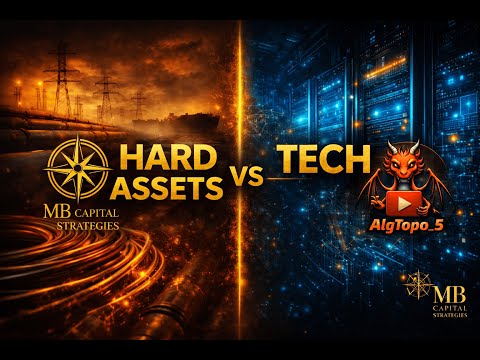
Finanzfeuer Talk episode 4: Hard assets vs. tech stocks debate. Marco argues for Hard Assets (Shipping, Mining, Energy, REITs) over tech at current valuations: lower P/E, real cash flow, inflation protection, and actual dividend income vs. future promises. Not investment advice.
Hard Assets vs Tech Stocks: Which Wins in the 2025-2030 Cycle?
Finanzfeuer Talk episode 4 debate: Hard assets (shipping, mining, energy) offer real FCF and dividends today; tech relies on future earnings multiples. In inflationary environments ($3%+ CPI), hard assets historically outperform. Marco's thesis: both can coexist — but for income investors, hard assets with 6-15% yields are superior to zero-dividend tech. Not investment advice.
Hard assets or tech: what dominates the next decade? With AlgTopo.
Marco and AlgTopo analyze one of the key market contradictions of 2026: while tech stocks trade at all-time highs on the AI boom, many hard asset sectors trade at multi-year lows — despite structurally growing physical demand.
The CAPEX Underinvestment Argument
Years of underinvestment in mines, oil fields and infrastructure has structurally capped supply. Key areas:
Copper: Global demand from EVs, solar, and data centers. New mine projects take 10-15 years. Supply gap visible from 2027.
Shipping: Order books at historic lows. New LNG tankers and VLGC vessels need 3-4 years to build.
Oil & Gas: Insufficient exploration spending since 2014.
The AI Boom Needs Hard Assets
The often-missed argument: AI boom and hard assets aren't opposing forces — they're complementary. Data centers need copper cables, cooling water, electricity. Power grids need copper, aluminum, steel. AI doesn't compete with mining stocks — AI is their demand driver.
Marco's Portfolio Verdict: Hard Assets Over Tech in 2026-2030
My portfolio allocation in 2026 reflects this thesis directly. I hold no pure-tech growth stocks. Instead, the portfolio is concentrated in hard-asset dividend payers across shipping, mining, and energy. Here's why:
Valuation differential: Most FAANG/Magnificent-7 tech stocks trade at 30-50x earnings. My hard asset holdings average 5-8x earnings with 6-10% dividend yields. The margin of safety is incomparably higher in hard assets — at the cost of lower momentum exposure.
The cashflow argument: Tech companies generate impressive operating cash flows but reinvest most of it into R&D, buybacks, and new product development. Hard asset companies in mature cyclical phases return 40-60% of free cash flow directly to shareholders as dividends. For an income-focused strategy targeting financial freedom by 2035, dividends are the mechanism — not capital gains.
The inflation hedge: Hard assets are real assets — ships, mines, pipelines have intrinsic replacement value that rises with inflation. Tech assets are largely intangible and inflation-neutral. In a structurally inflationary environment (as we see post-2020), real assets are the natural hedge.
This does not mean tech is a bad investment — just that it's the wrong fit for my specific strategy and risk profile. Both can coexist in a portfolio. For me, Hard Assets are the core thesis.
Listen to the Full Episode
The podcast episode covers additional topics including specific stock picks, entry points discussed between Marco and AlgTopo, and the portfolio construction debate. Available on Spotify under "Der Finanzfeuer Talk" and Apple Podcasts.
We use cookies and Google Analytics to improve your experience. By clicking "Accept", you consent to the use of cookies for analytics and ads. Privacy Policy