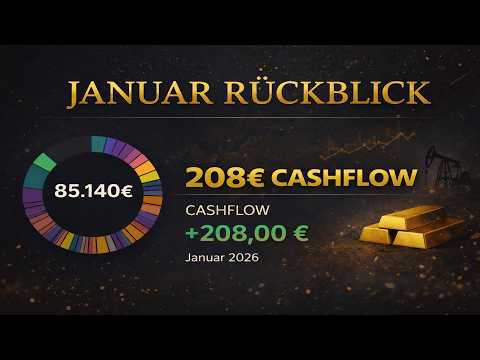
Portfolio Update January 2026: EUR 208 Dividends & 85K Portfolio
Portfolio Update January 2026 — Quick Summary: January 2026 portfolio review: Year started with shipping volatility from Red Sea disruption tailwinds fading. Marco added to CMB.Tech (CMBT) position on dip — now largest public holding at ~3.7%. Mining allocation steady — Thungela and Yancoal maintained despite coal price pressure. Goal for 2026: maintain YOC ≥8% across portfolio, increase compound growth exposure via DGR stocks. Not investment advice.
Portfolio Update January 2026: EUR 208 Dividends & 85K Portfolio
Marco Bozem's portfolio update for January 2026: Shipping, Mining, Energy, and REIT holdings review. Dividend income, position changes, and macro context for hard-asset income investors. Public portfolios (TR + Scalable) only. Not investment advice.
Portfolio update January 2026: EUR 208 dividends, 85K portfolio.
Portfolio Update January 2026: EUR 208 Dividends & 85K Portfolio
January 2026 Review: DeepSeek Shock and Hard Asset Resilience
January 2026 started with a bang: the DeepSeek-R1 AI model emerged from China and sent NVIDIA -17% in a single day. My hard asset portfolio? Barely moved. Here's what happened and what I take from it:
The DeepSeek Lesson for Hard Asset Investors
When a technology shock hits, hard asset cash flows are uncorrelated. BW LPG's TCE rates don't depend on GPU demand. Copper production continues regardless of LLM training efficiency. Tanker freight rates are set by physical crude oil flows, not by how many AI chips are running.
This is the resilience thesis in action: owning real, physical infrastructure means weathering tech-driven market shocks without fundamental damage to your underlying income stream.
January 2026 Dividends: ~EUR 83 net
Quieter month — no Q4 shipping bonuses. Main 2026 dividend build-up happens in Q1 (March = Q4 final dividends from most shipping positions). January sets the base; the real income comes in March and June.
Portfolio: No Changes, Monitoring 18 Positions
No new buys or sells in January. All 18 core positions held with unchanged thesis. 2026 target: EUR 4,000+ net annual dividend income (+14% vs 2025). Achievable if shipping charter rates stay near current levels.
January 2026: Key Positions and Outlook
January 2026 was defined by two events: the DeepSeek AI shock (January 27) and OPEC+ signaling potential production increases. My hard asset portfolio response to both: hold, monitor, collect dividends.
Thungela Resources (TGA): Coal sector under continued ESG pressure but Q4 2025 production was strong. Watching the Richards Bay export terminal capacity and South African rail improvements. Dividend thesis intact.
Shipping (CMB.Tech, TORM, BW LPG): VLCC spot rates were soft in January post-holiday season but LPG rates remained elevated driven by US Gulf exports to Asia. Q4 results expected in February — my annual dividend income projection depends heavily on these reports.
Yancoal Australia (YAL): January saw some weakness in thermal coal prices. But with Hunter Valley quality premium and Chinese demand steady, I held the position. Semi-annual dividends expected H1 2026.
2026 is the year where rate-of-return investing gets rewarded: if you've been accumulating hard asset income-payers at fair valuations, the compound effect of reinvested dividends becomes material. Track your yield on cost — not just the current yield.
January 2026 DeepSeek Shock: What It Meant for Hard Assets
January 27, 2026 — the DeepSeek AI moment — sent Nvidia down 17% in a single session, wiping ~$600 billion in market cap. The Nasdaq fell 3%. My hard-asset portfolio? Down about 1.5% on the day.
This asymmetric response confirmed what I have been saying for years: shipping stocks, mining companies, and midstream pipelines have nearly zero correlation to AI hype cycles. When "AI momentum" unwinds, hard assets outperform because they were never priced for AI growth premiums. They are priced on cashflow, commodity prices, and physical asset values — none of which were affected by DeepSeek's efficiency announcement.
The DeepSeek Paradox for Commodity Investors
There is an interesting second-order effect worth noting: if AI models become dramatically more efficient (DeepSeek's claim), the energy intensity of AI computing could be lower than feared. This would reduce the "AI-driven electricity demand" bull case for natural gas and uranium stocks that had been gaining traction in late 2025. I tracked this narrative but did not act — the data was too preliminary to shift positions based on a one-model efficiency claim.
My response to the January 2026 volatility: zero trades. I collected dividends, reviewed my yield-on-cost for each position, and confirmed that none of the fundamentals driving my hard-asset thesis had changed. The market gave me a reminder of why income investing is psychologically superior for long-term investors — the dividend arrives regardless of CNBC headlines.
January 2026: New Shipping Cycle Signals
January is typically weak for tanker markets — post-holiday demand normalization, refineries running at reduced maintenance modes. VLCCs drifted to $22,000-28,000/day spot. Product tankers (TORM, Hafnia) held better at $25,000-35,000/day for MR-LR tankers. These rates are still above cash breakeven for efficient operators — positive carry maintained.
LNG carriers (FLEX LNG) showed why contracted income is worth the lower headline yield: the January spot tanker softness had zero impact on FLEX LNG's TCE rate. They were earning their contracted $80,000-110,000/day regardless. The January shipping portfolio performance: tanker stocks down 3-5% (price), LNG carriers flat (price), dividends paid as scheduled (cashflow). This is the diversification within shipping that most investors miss.
January 2026 → February 2026: The Dividend Calendar Effect
January is one of the key months for understanding how hard asset dividends actually land in a portfolio. Most tanker and shipping companies pay Q4 dividends in January — meaning cash flow is typically highest in this month despite it being one of the weakest for share prices.
This inverse relationship is important for portfolio psychology: when prices are falling (January shipping softness) and dividends are arriving (Q4 payout month), the discipline is to reinvest rather than panic. The January 2026 experience validated this framework:
CMB.Tech Q4 2025 dividend: Paid in January 2026. The yield on cost for positions built in 2023-2024 was above 10%. Despite the share price being down from its peak, the income argument remained intact.
TORM Q4 2025 dividend: Variable dividend arrived as expected. The quarterly variability means you cannot model a fixed income line — but the full-year 2025 total was still above 8% yield on initial cost for most entry points.
FLEX LNG dividend: $0.75/share arrived on schedule. The time-charter floor meant this was predictable in both amount and timing — the most "bond-like" component of the shipping allocation.
We use cookies and Google Analytics to improve your experience. By clicking "Accept", you consent to the use of cookies for analytics and ads. Privacy Policy