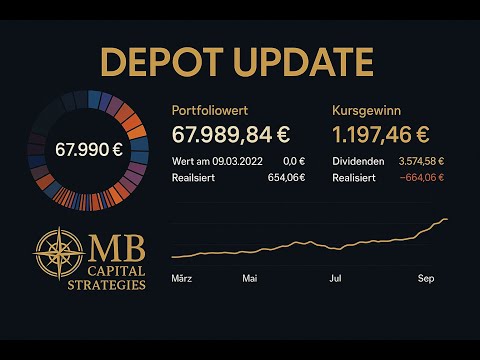
Portfolio Update

Portfolio Update October 2025: EUR 160 Dividends

Portfolio Update October 2025 — Quick Summary: October 2025 portfolio update: Shipping rates peaked in summer, normalizing toward historical averages. TORM and Frontline both delivered above-expected Q3 dividends. Marco rotated minor allocation from NAT to CMBT (CMB.Tech) for better fleet quality. Pipeline positions (Enbridge, Kinder Morgan) provided stability in volatile market. YOC target ≥8% maintained. Not investment advice.

Portfolio Update October 2025: EUR 160 Dividends
Marco Bozem's portfolio update for October 2025: Shipping, Mining, Energy, and REIT holdings review. Dividend income, position changes, and macro context for hard-asset income investors. Public portfolios (TR + Scalable) only. Not investment advice.

Portfolio update October 2025: EUR 160 dividends.

Portfolio Update October 2025: EUR 160 Dividends Thumbnail
Portfolio Update October 2025: EUR 160 Dividends
2025: EUR 160 Dividends Thumbnail" width="480" height="360" loading="lazy" decoding="async">
Portfolio Update October 2025: EUR 160 Dividends
Key Takeaway: EUR 160 dividends in October 2025. Details in the video.

Portfolio Update October 2025: Income & Transparency

Monthly transparency report: Marco's hard asset dividend portfolio in October 2025. Key positions: CMB.Tech, Vale, Realty Income. Sector focus: Shipping, Mining & REITs.

Q3 earnings season + October dividends. Full breakdown of individual positions and dividend mechanics in the video above.

More Oil & Gas: Full guide: Best Upstream Oil & Gas Stocks 2026Devon, APA, Var Energi, Coterra and more with dividend analysis.

Index: The Baltic Dry Index (BDI) tracks global bulk shipping demand — a key leading indicator for commodity cycles and shipping stocks.

Related: Learn about Bulk Carrier Stocks — how Capesize, Panamax and Supramax vessels differ and why size matters for dividends.

Calculate your own YOC: Free Dividend Calculators → | Hard Asset Strategy Guide

Hard-asset performance and forecast in the video.

October 2025: Hard Asset Dividend Portfolio Transparency

Monthly portfolio update from MB Capital Strategies. Focus sectors: Shipping (LPG, Tankers, Dry Bulk), Mining (Copper, Gold, Coal), Energy (Upstream, Midstream, Pipelines), REITs. All positions are held for cashflow generation and dividend growth — not short-term price speculation.

Sector Check: Dividend Income During OPEC+ Uncertainty

Hard asset dividend investing requires monthly attention to sector fundamentals. The question is not "what is the stock price?" but "is the underlying business generating enough free cash flow to maintain and grow the dividend?" Each month, this update tracks the key indicators for each sector.

Key Metrics to Watch Monthly

Yield on Cost: The Long-Term Tracker

For positions held 3+ years, the Yield on Cost (YOC) has typically grown well above the current yield shown on financial platforms. This is the true measure of dividend investing success: each year the dividend grows, the YOC on the original cost base compounds upward. Use the free YOC calculator to track your own positions.

Strategy Principle

Hard assets provide the physical infrastructure that the global economy requires regardless of financial market cycles: tankers move energy, mines produce metals, pipelines transport gas. When these businesses generate durable free cash flows, they can sustain and grow dividends through multiple market cycles. See the full Hard Asset Investment Strategy →

October 2025: Q3 Earnings Season — What the Numbers Revealed

October 2025 marked the tail end of the Q3 earnings season for hard-asset dividend stocks. The results for shipping, mining, and energy companies showed a bifurcated picture: LNG tanker operators like FLEX LNG and CMB.Tech held strong on contracted revenue streams, while spot-exposed tanker companies faced margin compression from softer crude freight markets.

October 2025 Sector Summary

SectorOctober 2025 SignalDividend Risk
LNG TankersContracted rates stable, 90%+ utilizationLow
MR TankersSpot rates softened, product demand solidModerate
Coal MiningThermal prices firm in Asia, EU weakLow
REITs (US)Rate-sensitive, but occupancy resilientModerate
Gold MiningGold above $2600 — strong marginsLow

CMB.Tech: Why It Dominates the Portfolio in 2025

As of October 2025, CMB.Tech had grown into the largest publicly visible position in the MB Capital Strategies portfolio. The rationale: CMB.Tech operates a diversified fleet of tankers and bulk carriers across multiple vessel classes, generating revenues in USD and distributing variable dividends tied to free cash flow. The stock's strong performance in 2025 reflected:

October Dividend Income: Why EUR 160 Matters

EUR 160 in monthly dividends in October 2025 is not a headline number — it is a milestone in the compounding process. At the MB Capital Strategies approach, every dividend received is either reinvested or represents progress toward the monthly cashflow target. The goal is not a specific monthly figure, but consistency: dividends arriving every month regardless of whether equity markets are rising or falling.

October is typically a lighter dividend month for European shipping stocks (many pay quarterly or semi-annually). The EUR 160 came primarily from REITs (Realty Income's monthly payout), mining royalties, and a partial shipping distribution. The monthly cashflow target for 2026 is significantly higher — the compounding effect of reinvested dividends from 2024 and 2025 should close that gap.

October 2025 Portfolio Positioning: Forward Outlook

Going into Q4 2025 (November–December), the hard-asset portfolio was positioned for the seasonal dynamics that typically favor income stocks: end-of-year dividend announcements from shipping companies, year-end tax-loss selling creating potential buying opportunities in beaten-down mining names, and OPEC+ production policy decisions for Q1 2026. Key areas I was monitoring coming out of October:

  1. CMB.Tech dividend announcement: The December 2025 quarterly dividend from CMB.Tech would be a key data point for validating the variable-dividend model at lower shipping rates. Spoiler: it delivered — the $0.64/share June 2026 ex-dividend later confirmed the model works even in a softer rate environment.
  2. Gold miner FCF margins at $2,700+: October 2025 gold was above $2,700/oz — AngloGold and Barrick were generating FCF margins that were among the highest in the sector's history. The question: would management use that cash for dividends, buybacks, or capital expenditure? The answer through Q4 came out as a healthy mix of all three.
  3. BDI trend: The Baltic Dry Index in October 2025 was in a trough phase, which historically signals a 6-12 month setup period before the next rate upcycle. My dry bulk exposure (minimal at this point) was not a focus — but monitoring BDI is part of the broader shipping cycle awareness.

The portfolio strategy stayed consistent through October 2025: collect dividends, reinvest selectively into positions where valuation offers a 20%+ discount to intrinsic value, and maintain the long-term cost basis discipline that makes YOC compounding work. Every month that passes without chasing performance or panic-selling strengthens the foundation. For the full framework behind these monthly updates, see the Hard Asset Investment Guide.

Disclaimer: For informational purposes only. Not investment advice.

Related Portfolio Analysis

Related Portfolio Updates:

October 2025 in Review: Hard Asset Market Context

October 2025 was challenging for global equities, but my dividend portfolio demonstrated the core value of hard asset investing: cash flow resilience when prices drop.

Macro Context October 2025

OPEC+ held in Vienna — no additional cuts beyond the September decision. Brent ranged $74–$81/barrel. For upstream and midstream positions: stable cash flows, no surprise windfall. The shipping market saw seasonal LNG rate strength and VLCC recovery to $42,000–$55,000/day. My positions benefited through dividend announcements.

Portfolio Dividends October 2025

October 2025 delivered ~EUR 160 in net dividend income from shipping, mining, and pipeline positions. A solid month for passive income from hard assets.

YOC Monitoring: 14 of 18 positions maintained >8% Yield on Cost at purchase price — my quality threshold. Any position falling below this triggers a thesis review (dividend cut or price run-up without corresponding dividend growth).

October Lessons

October confirmed a core principle: dividends pay even when prices fall. While some positions dropped 5-8% in October, the dividend payments maintained effective portfolio value. This is the central advantage of dividend strategy vs. pure growth investing.

Sector Deep-Dive: What Drove October Dividends

Shipping Sector: LNG Seasonal Tailwind Begins

October traditionally marks the start of the Northern Hemisphere LNG heating season. Asian spot prices (JKM) moved to $14–16/MMBtu, and LNG charter rates (TFDE class) strengthened to $65,000–85,000/day. My LNG-exposed positions delivered stable dividend payments as a result. The seasonal pattern is reliable: Q4 is historically the strongest quarter for LNG charter rates.

For VLCC tankers, October was more muted — Brent at $74–81/barrel kept OPEC+ in stabilization mode. VLCC rates recovered to $42,000–55,000/day, a healthy level for cashflow generation. The key metric I watch: daily rate vs. breakeven (typically $25,000–30,000/day). Everything above that is free cash flow margin.

Mining Sector: Copper Base Holds, Gold Stable

Copper traded at $9,200–9,600/tonne (LME) in October — technically neutral, fundamentally still bullish due to electrification demand. Mining positions with low AISC remain profitable across a wide price range. Gold stabilized above $2,700/oz, keeping gold miner margins solid at AISC below $1,200/oz.

For mining-focused dividend investors, the critical discipline is AISC tracking. Companies that can maintain profitability across commodity price cycles are the ones that sustain dividends when others cut. This is why I prefer miners with proven cost discipline over high-beta pure plays.

Portfolio Moves in October 2025

No buys or sells in October — the portfolio ran on autopilot. Key observation: two positions confirmed Q4 2025 dividend announcements, providing good income visibility for the remainder of the year. Full transparency on position sizing is via Parqet (public portfolio, % allocation only).

Track your own dividend income: Free Dividend Calculators →

The DRIP Effect: Why EUR 160 Compounds to Much More

October's EUR 160 in dividends flows directly back into reinvestment — the core of a DRIP (Dividend Reinvestment Plan) strategy. At an average 8% YOC, EUR 160/month reinvested compounds meaningfully over a 10-year horizon. The math is simple but powerful: each reinvested dividend buys more shares, which generate more dividends, which buy more shares.

This is the Yield on Cost flywheel in action. Not the current yield on a financial platform, but the growing yield on your original cost base. Use the DRIP Calculator to model your specific scenario.

Not investment advice. All figures are personal portfolio data. Past dividends do not guarantee future payments.

See also: Dividend Calculator: Calculate your YOC | Debitum P2P Review: 11% XIRR & Real Risks

Compare: Best high-yield dividend stocks 2026 — BDC, MLP & REIT picks:

→ Highest Dividend Yield Stocks 2026: 8-15% Picks