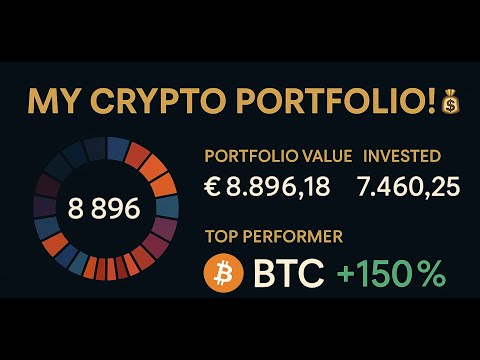
The Context: Why Crypto Alongside Hard Assets?
My primary investment thesis is built around hard assets that generate real cashflow — shipping operators, mines, pipelines, energy producers. These pay dividends. They have tangible assets. They are not reliant on sentiment. Crypto is the opposite: pure store-of-value/speculation, no cashflow, maximum sentiment-dependence. So why hold it? Because a 5% allocation to an asset that can 2–3x in a bull market adds meaningful portfolio outperformance without risking the core thesis.
Passive Income Beyond Stocks: Debitum Review 2026 — 15% P2P yield with forest & agricultural loans? Honest reality check.
Bitcoin: The Only Long-Term Crypto Conviction
Bitcoin is the only crypto I would consider holding through a full market cycle. The case: fixed supply (21M coins), growing institutional adoption (spot ETFs launched 2024), and a developing narrative as digital store-of-value. The 2024 halving (April 2024) reduced new BTC issuance — historically this has preceded the major bull cycle. The +158% in 2024 reflects that cycle. I am not calling a top here; what I am saying is that BTC has stronger long-term structural arguments than any other cryptocurrency.
XRP and BNB: Speculative Satellite Positions
XRP (+199%) benefited from the 2023–2024 SEC lawsuit outcome (partial victory for Ripple) and payment-focused adoption narratives. BNB (+129%) is tied to the Binance exchange ecosystem — strong network effects, but regulatory headline risk. Both positions are significantly smaller than my BTC allocation. Mental stop: if the crypto narrative reverses structurally, I reduce these first. Compared to a BW LPG dividend or a South32 mining cashflow, these are speculation, not investment.
Tool: Financial Freedom Calculator — calculate when you can live off dividends based on your target income and current portfolio yield.
Glossary: Charter Rates explained — how spot vs time charter rates drive tanker and dry bulk stock valuations and what rate cycles mean for dividends.
Tool: Shipping Cashflow Estimator — model the daily/annual revenue of tanker or dry bulk vessels at different charter rates.
Lessons for 2026: What Would I Change?
In hindsight, a larger BTC allocation and smaller altcoin allocation would have been optimal. Altcoins underperform BTC on a risk-adjusted basis over most 2+ year windows. For 2026, my focus remains on the hard asset dividend core — but I maintain a small BTC position as the "asymmetric bet" leg of the portfolio. The Dividend Calculator is irrelevant for crypto (no yield), but it is central to how I think about every hard asset position I build.
Crypto vs. Hard Asset Dividends: The Real Trade-Off
After running both crypto and hard asset dividend positions simultaneously, here is the honest comparison for income-focused investors:
| Factor | Crypto (BTC) | Hard Asset Dividends |
|---|---|---|
| Annual Yield | 0% | 6–15% (Shipping/Mining) |
| Volatility | Extreme (50–80% drawdowns) | High (30–50% drawdowns) |
| Cashflow | Zero — price appreciation only | Quarterly/annual dividends paid in cash |
| Tax Treatment (DE) | 25% Abgeltungssteuer on gains (>1yr = 0% for some) | 25% Abgeltungssteuer on dividends + Quellensteuer |
| Inflation Hedge | Theoretical (digital scarcity) | Real (physical commodities, pricing power) |
My conclusion after 2025: Crypto belongs in a hard asset portfolio as a speculative 2–5% satellite allocation — not as core income. The dividend income from one solid tanker position (e.g., TORM at YOC ~12%) exceeds what a comparable crypto allocation would ever generate in cashflow. For income-seeking investors, the math is clear: hard assets pay, crypto speculates.
Portfolio Allocation Framework: Crypto's Place
Here is how I currently think about the crypto allocation within a hard asset income portfolio:
- BTC 2–3%: Digital gold equivalent — store of value thesis, long-term hold, never leveraged. Only add on 40%+ corrections.
- Altcoins (XRP, BNB) 0–2%: Speculative satellite. Position sized so a complete loss doesn't affect the income goal. If it goes to zero: no lifestyle impact. If it 10x: a nice surprise.
- No yield-generating crypto products: Staking, lending, DeFi — counterparty risks are opaque and not worth the complexity in a dividend-focused portfolio.
- Hard asset core (>90%): Shipping + Mining + Energy + Pipelines + REITs. This is where the income actually comes from.
Crypto Risk Management for Hard Asset Investors
If you are going to hold crypto alongside hard assets, these risk management principles matter:
- Never leverage crypto positions: The volatility of crypto assets combined with margin means total account wipeouts are possible in a single bad week. Hard asset income investors protect their income base first — never risk it on leveraged crypto.
- Custody security: Hold Bitcoin via hardware wallets or regulated custodians (no self-custody unless you understand key management completely). Exchange failures (FTX 2022) destroyed billions in uninsured crypto holdings. Your hard asset brokerage account has regulatory protections; crypto exchanges often do not.
- Tax optimization (Germany): German law requires 1-year holding period for crypto to be tax-exempt on gains (Haltefrist). Plan entries/exits around this. Frequent trading creates a cascading tax burden that destroys net returns.
- Correlation in crashes: Crypto and risk assets (equities, commodities) historically crash together in liquidity crises. Do not assume crypto provides portfolio diversification during the worst market moments — it typically doesn't.
2026 Crypto Landscape: What Changed from 2025
The crypto market evolved significantly between 2025 and 2026:
- Bitcoin ETF approval: Spot BTC ETFs in the US drew massive institutional inflows, reducing volatility and deepening the market. Bitcoin's institutional legitimacy as a reserve asset strengthened.
- Ethereum staking yields compressed: As staking participation increased, ETH staking yields fell to ~3–4%. This is no longer competitive with hard asset dividends (8–15%) once tax friction is accounted for.
- Regulatory clarity (EU MiCA): EU's Markets in Crypto Assets regulation reduced some uncertainty for European investors, but compliance costs increased for exchanges operating in the EU.
- DeFi still experimental: Despite years of development, DeFi protocols continue to experience exploits and governance failures. Not suitable as a yield source in a conservative income portfolio.
How safe is the dividend? → Dividend Coverage Ratio Explained →
Calculate your hard asset yield → YOC Calculator: Your Yield on Cost →
Crypto vs. Hard Assets: The Real Alternative
Bitcoin and Ethereum are stores of value (or speculation vehicles) — not income generators. Marco's portfolio philosophy is built on the opposite: assets that generate real cash flows, pay dividends, and have hard tangible backing. The contrast is stark:
- Crypto (BTC, ETH): No yield unless lent or staked. Price-only return. Maximum volatility. No claim on underlying cash flows.
- Tanker stocks (CMB.Tech, TORM, Frontline): 8–15% dividend yield backed by shipping contracts and real asset dayrates. Tangible ships as collateral.
- Mining stocks (Thungela, Barrick, BHP): 5–12% yield backed by proven ore reserves and production cash flows. Price of gold, copper, coal = real market prices.
- LNG stocks (FLEX LNG): 9%+ yield backed by 7–10-year time charter contracts. Charter rate locked in — cash flows nearly as predictable as bonds. See: FLEX LNG Q1 2026 analysis.
- Pipeline stocks (Enbridge): 6–7% yield backed by take-or-pay contracts (98% revenue certainty). Almost utility-grade income stability.
The conclusion: a small speculative crypto allocation (1–3% of portfolio) can coexist with a hard-asset dividend portfolio. But crypto should never substitute for income-generating positions — it generates no income by design. For income-focused investors, the hard asset sectors above offer better risk-adjusted income than crypto at current valuations. Related: Hard Assets Explained | Best Tanker Stocks 2026 | TCE Rate Guide.